



Upper Bergamo, Piazza Garibaldi
Sestini Museum of Photography, Bergamo. Late 1800s–early 1900s. Domenico Lucchetti, Domenico Lucchetti Collection, Collection of Events, Portraits, and Views of the Region, Angelini Collection 72
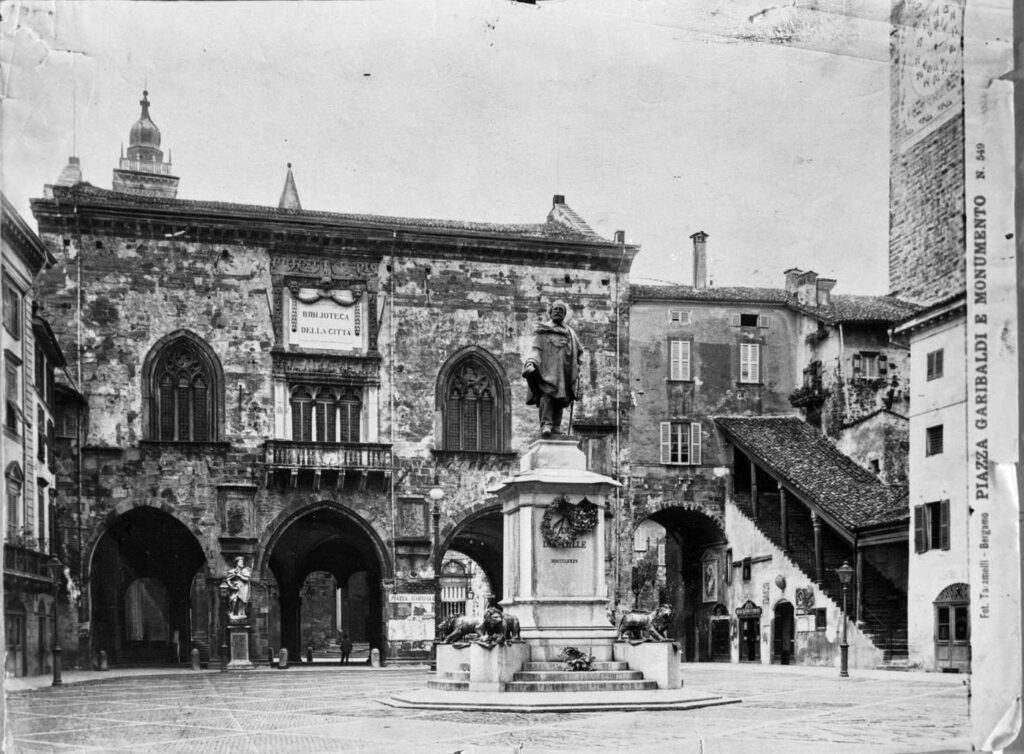
The photo shows Piazza Vecchia as it appeared in the late 19th century, without the symbols of the ancient Republic of Venice (which were removed during Austrian rule) and with some architectural differences.
In the center, you can clearly see the monument to Giuseppe Garibaldi, placed here after the unification of Italy, the Palazzo della Ragione without the bas-relief depicting the lion of Venice, and, next to it on the right at the top of the covered staircase, the walkway leading to the Sala delle Capriate, which was still part of a residential building at the time (it was, in fact, a private residence).
The center of Bergamo’s political power for centuries, Piazza Vecchia is still today the place where people meet and spend their free time.
Compared to the late 19th century, it has undergone various changes and numerous renovations: the monument to Garibaldi no longer stands in the center of the square—it has been relocated to the Rotonda dei Mille in the Lower City—but rather the traditional Contarini Fountain, a gift from Podestà Alvise Contarini in 1780; the bas-relief featuring the Lion of Venice has been restored to its place on the façade of the Palazzo della Ragione, now cleansed of the ravages of time; the house that once stood above the arch leading to Piazza Duomo has been demolished and replaced by the current walkway providing access to the Sala delle Capriate (on the first floor of Palazzo della Ragione).
Similarly, over the decades, nearly all of the buildings surrounding the square have been restored and renovated.