



This historic photo shows Via delle Tre Armi and the southwestern side of the Venetian Walls covered in snow, with the Piattaforma and the Cortina di Santa Grata in the foreground and the Baluardo di San Giacomo in the background. Among the historic buildings, the silhouette of the Liceo Classico Paolo Sarpi, with its neoclassical pediment, stands out in a nearly central position.
This photo was taken in the mid-1990s, so it’s fairly recent, but the only real signs of the passage of time compared to photos from the early 20th century or the 19th century are the paved road and the density of buildings that have sprung up in the “green belt” that has always surrounded the fortifications.
Has this place changed over the past thirty years?
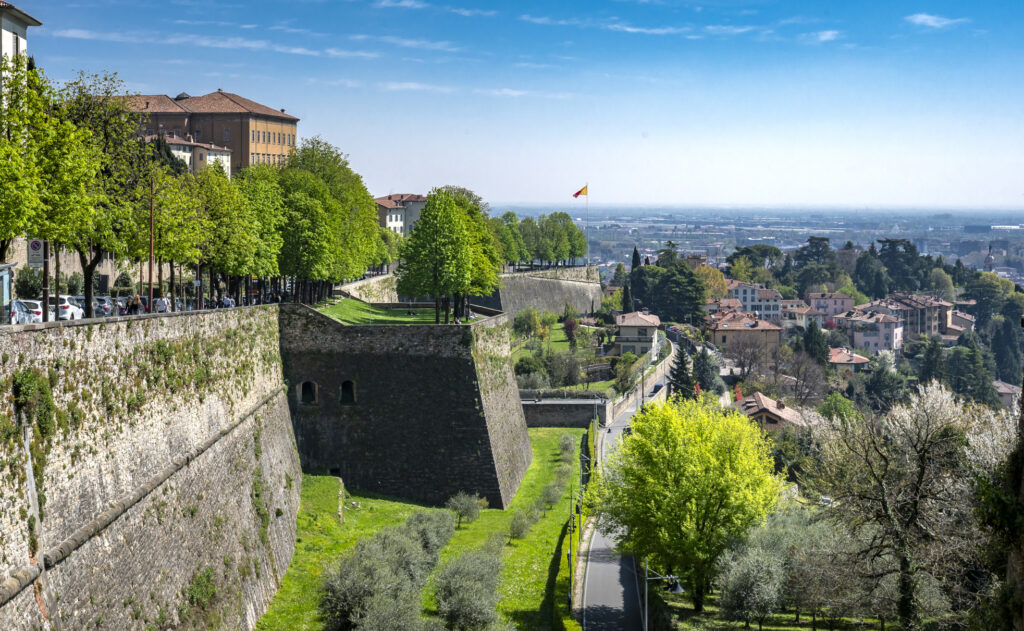
Bergamo would not be the same without its city walls: an imposing masterpiece of civil engineering that, at the end of the 16th century, profoundly transformed the city’s appearance, giving it an unmistakable character that still amazes and captivates visitors today. This impregnable curtain of stone, earth, and rock has protected the old town for four centuries without ever being attacked, constantly maintained by the people of Bergamo to preserve its functionality and beauty.
Over the past decade, maintenance has been redefined and codified according to a precise plan, ensuring conservation efforts that go beyond merely addressing emergency areas and instead comprehensively involve the entire fortification complex.
This project is closely linked to the designation of the Venetian Walls as a UNESCO World Heritage Site within the serial and transnational site “The Venetian Defense Works of the 16th and 17th Centuries: Stato da Terra – Stato da Mar Occidentale.”
Looking at the 1994 photograph, one cannot help but think that the idea of consistent and planned maintenance was already taking shape, given that the walls appear, at least in the Via delle Tre Armi area, to be in good condition.